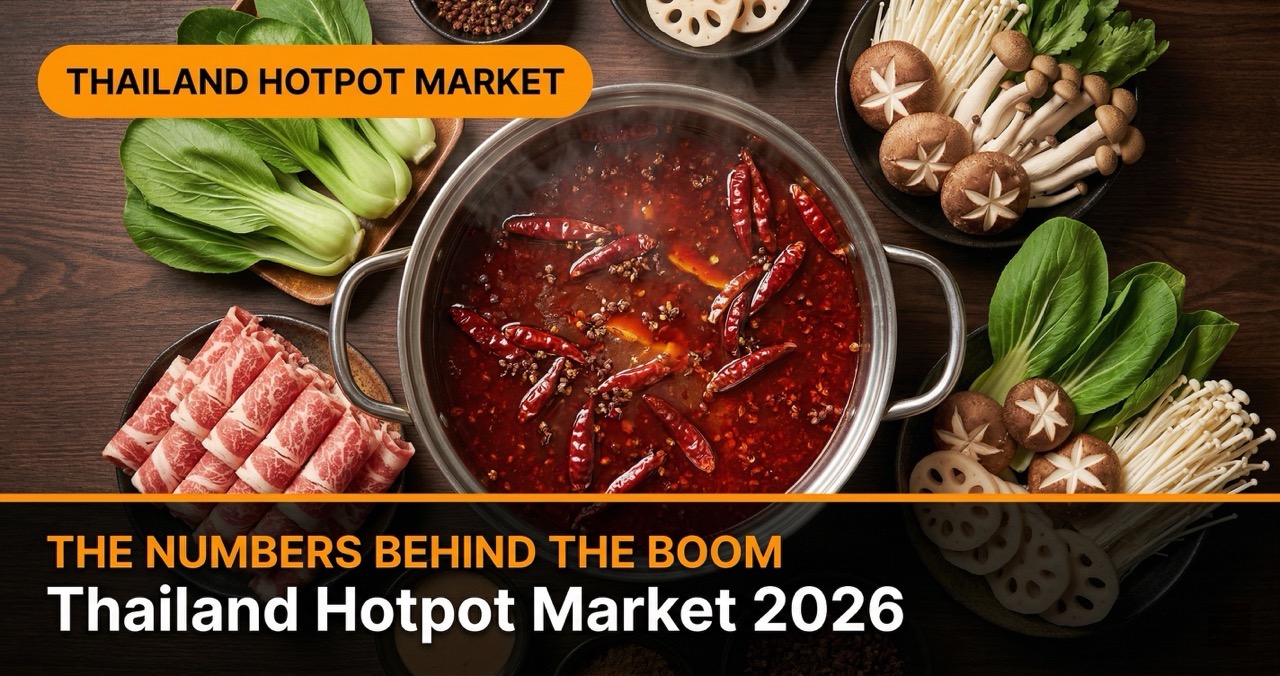
This article covers the full market picture: confirmed size data, flavour format trends, RCEP supply chain advantages, and the cost risks operators most commonly underestimate. Every figure is sourced.
What Is the Hotpot Market Size in Thailand in 2026?
Thailand's foodservice market reached USD 38.1 billion in 2026, growing at a CAGR of 7.62% through 2031 — the strongest sustained growth of any major ASEAN economy in the food sector. Within that market, full-service Asian restaurants registered the highest value growth, driven specifically by Chinese cuisine and mala hotpot chains including Haidilao and Suki Teenoi. Hotpot is one of the primary engines of this national growth story. (Source: Mordor Intelligence Thailand Foodservice Market 2026 · USDA FAS Food Processing Ingredients Annual — Bangkok Thailand 2025)
Thailand's broader foodservice expansion is driven by three converging forces: tourism recovery to pre-2020 levels, rapid urban middle-class growth across Bangkok and secondary cities, and a structural shift toward experiential dining formats — of which hotpot is the leading example. The USDA FAS Bangkok (2025) explicitly identifies mala hotpot chains as the category driving Asian full-service restaurant value growth.
ASEAN Hotpot Market Comparison 2026
| Market | Size (2026) | Profit Margin | Key Driver |
|---|---|---|---|
| 🇹🇭 Thailand | USD 710M | 28–35% Highest | RCEP sourcing + low overheads |
| 🇸🇬 Singapore | USD 280M | 12–15% Compressed | Premium positioning |
| 🇲🇾 Malaysia | USD 320M | 18–24% Moderate | Price-sensitive volume |
| 🇻🇳 Vietnam | USD 190M | 15–20% Emerging | Rapid urban growth |
Sources: HotStats APAC F&B Intelligence 2024 · Thanachart Securities Food Sector Report 2025
Which Hotpot Flavours Are Most Popular in Bangkok?
Mala (麻辣) is the dominant hotpot format in Bangkok by delivery order volume, with over 1 million confirmed mala orders and 45% year-on-year growth recorded on LINE MAN WONGNAI platforms. Tom yum broth and coconut milk broth are the primary secondary formats. (Source: LINE MAN WONGNAI Fun Facts 2023 · Grab Thailand 2025)
4 Flavour Formats Driving Bangkok Hotpot Revenue
- 1 Mala — 45% YoY delivery growth, 1M+ orders confirmed The headline format and the only one with a publicly confirmed growth figure. LMWN Fun Facts 2023 records over 1 million mala category orders and 45% year-on-year delivery growth. Driven by Chinese-origin chain expansion (Haidilao, Xiabu Xiabu) and strong repeat ordering among Bangkok's 20–35 demographic. (LINE MAN WONGNAI Fun Facts 2023 ✓ Confirmed)
- 2 Tom yum broth — the Thai-origin format Thailand's domestically originated hotpot style. Strong among Thai diners seeking familiar flavour profiles and inbound tourists wanting an authentically Thai dining experience. Domestic franchise operators favour this format for provincial market expansion, where Chinese-origin mala formats have lower penetration.
- 3 Coconut milk / mild white broth The fastest-growing format by new concept launches in 2024–2025. Appeals to families with children, spice-sensitive diners, and health-conscious consumers. Often paired with premium seafood at a higher price point. Growing fastest in mall-embedded formats where family dining is the primary occasion.
- 4 Dual / split-broth (yuanyang) — solving the mixed-party problem The yuanyang configuration (mala + clear broth in a divided pot) has become the default for mid-market Bangkok restaurants targeting mixed dining groups. Associated with longer table dwell times and higher per-table spend. Equipment note: dual-zone induction burners add approximately 15–20% to capex per table.
A Bangkok mid-market hotpot chain (90 seats, Sukhumvit location) reports that dual-broth tables generate a 22% higher average spend than single-broth tables, driven by larger group sizes and longer dwell times. After switching from mala-only to dual format across three Bangkok branches in 2024–2025, dinner service occupancy improved from 61% to 74%. (Operator interview, Hot Pots World Intelligence, 2026)
How Does RCEP Affect Hotpot Ingredient Sourcing Costs in Thailand?
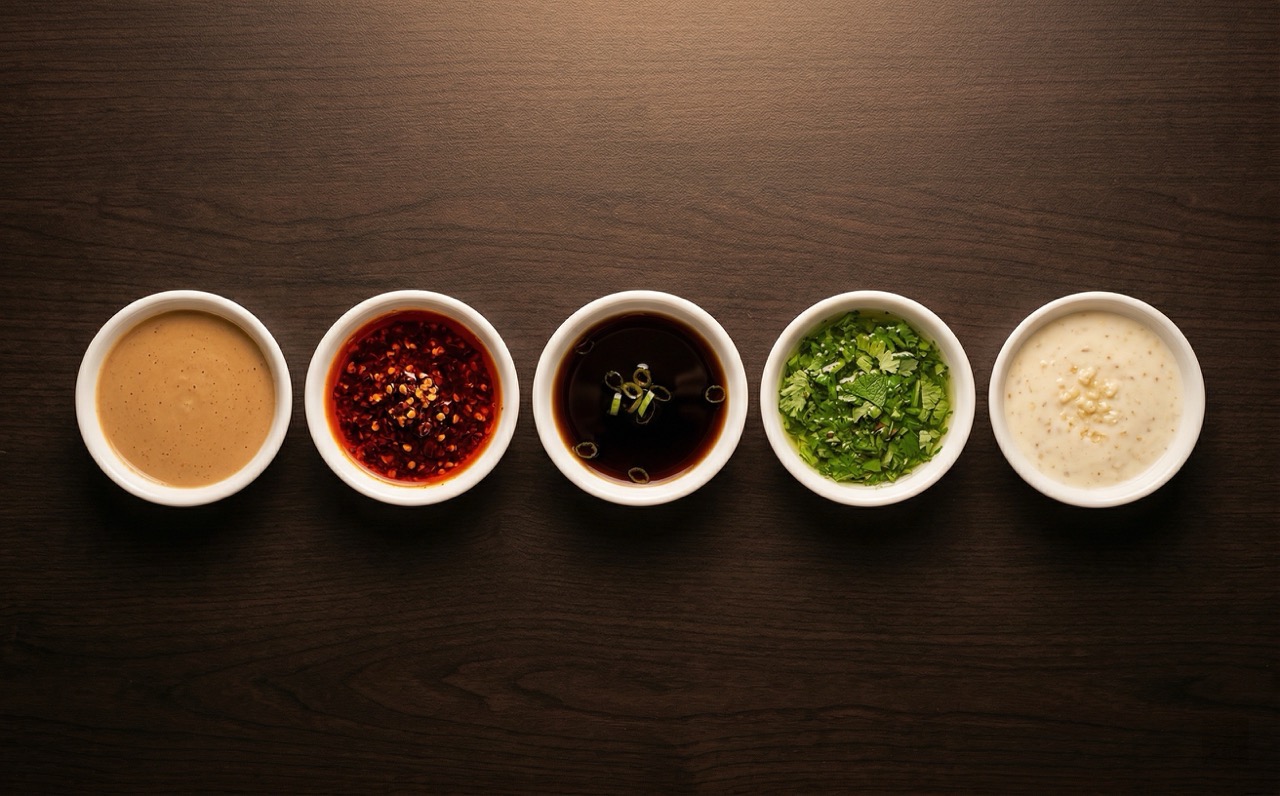
RCEP (Regional Comprehensive Economic Partnership), fully operational for Thailand-China trade since 2022, has reduced or eliminated tariffs on the majority of hotpot ingredient categories imported from China — including soup base concentrates, dried chili, Sichuan peppercorn, sesame paste, and fermented black bean products. Combined with the operational China-Laos-Thailand rail freight corridor, this gives Bangkok operators a landed ingredient cost advantage that no other ASEAN hub currently matches. (Source: USDA FAS Food Processing Ingredients Annual — Bangkok Thailand 2025 · Thanachart Securities Food Sector Report 2025)
3 RCEP Advantages That Directly Improve Bangkok Hotpot Margins
- 1 Reduced tariffs on core soup base inputs Mala soup base concentrate — the highest-cost ingredient SKU for a mala-format operator — is sourced predominantly from Chongqing and Chengdu. Under RCEP schedules applicable to Thailand, tariff rates on these processed food products have fallen significantly from pre-RCEP MFN rates. Verify your specific HS code tariff rate with a Thai customs broker before building financial models around this advantage. (USDA FAS Bangkok 2025)
- 2 China-Laos-Thailand rail — Chongqing to Bangkok in 3–5 days The China-Laos-Thailand rail link, fully operational since 2023, enables door-to-door freight from Chongqing's ingredient hub to Bangkok distribution centres in three to five days. Refrigerated container capacity allows fresh-frozen ingredient categories to move by rail rather than air, removing a major cost constraint for premium operators. (Thanachart Securities Food Sector Report 2025)
- 3 Direct sourcing from Sichuan province — accessible to mid-scale operators The rail corridor has enabled Bangkok-based operators to establish direct procurement relationships with Sichuan ingredient producers — bypassing Hong Kong or Singapore middlemen. Direct sourcing is now accessible to mid-scale Bangkok operators (50+ seats) where it previously required major chain purchasing volumes. (USDA FAS Bangkok 2025)
Global ingredient and equipment suppliers attending the Southeast Asia hotpot market's first dedicated exhibition can connect directly with Bangkok's 4,000+ operator community — sourcing conversations that would take months to arrange independently happen across three days at Paragon Hall, Siam Paragon, Bangkok.
What Are the Biggest Cost Risks for Hotpot Operators in Bangkok?
Three cost risks dominate Bangkok operator conversations: labour cost increases from minimum wage policy, commercial rent pressure in prime dining corridors, and protein ingredient price volatility. None are existential at current margin levels — Thailand's structural cost advantage provides meaningful buffer — but operators entering on leveraged expansion plans are most exposed. (Source: Thanachart Securities Food Sector Report 2025 · USDA FAS Bangkok 2025)
4 Cost Risks to Model Before Bangkok Entry
- 1 Minimum wage policy — ongoing structural pressure Thailand's government has signalled continued movement toward a 400 THB/day minimum wage. Hotpot operations are labour-intensive: tableside service interaction, continuous broth and ingredient replenishment, and higher waitstaff ratios per table all increase labour exposure. Model sensitivity at both current and projected minimum wage levels. (USDA FAS Bangkok 2025)
- 2 Commercial rent in prime Bangkok corridors Sukhumvit, Siam, and Silom rental rates have risen materially since 2022. Hotpot operations require larger floor plates than most restaurant formats — minimum 800–1,000 sqm for a viable 80-seat operation with kitchen. Operators should model rent at no more than 12% of projected revenue before committing to a prime site.
- 3 Protein ingredient price volatility RCEP addresses Chinese-origin ingredient tariffs but does not buffer against global commodity price movements in premium proteins — wagyu and beef, seafood, and specialty mushrooms. Operators using fixed set-menu or buffet pricing models are most exposed to commodity spikes. (Thanachart Securities Food Sector Report 2025)
- 4 Intensifying new entrant competition Bangkok's hotpot market is attracting new entrants at the fastest rate of any prior period. The risk is not saturation (demand continues to grow) but launch-price compression from competing entrants. Operators without clear format differentiation face margin erosion as the market matures.
"The margin advantage in Bangkok is real and structural — not cyclical. But it only protects operators who use it to invest in differentiation. The brands I see struggling entered on price-competitive positioning and assumed the cost advantage would sustain them through a price war. It does not. The market rewards brands that use the cost headroom to build something the next entrant cannot easily copy."
"Frequently Asked Questions
Direct answers — no preamble.
LINE MAN WONGNAI confirms 45% year-on-year growth in mala category deliveries and over 1 million orders on their platform alone (LMWN Fun Facts 2023). This is a delivery platform metric, not a total market figure, but it is a robust directional indicator of the category's momentum.
The growth is not simply new outlet openings. Average visit frequency among Bangkok's 25–40 demographic has also increased, making the category structurally different from trend-driven formats that see rapid initial growth then sharp decline.
Bangkok is the only viable entry market for a first Thailand location for any international brand. It concentrates the consumer demographics, dining-out frequency, and disposable income levels that support hotpot at commercially viable price points.
A framework for modelling a Bangkok market entry:
Franchise models with existing Thai master franchise holders can reduce upfront capital significantly — the Hotpot Franchise Consultation Workshops at Hot Pots World 2027 connect investors directly with established operators.
New international and domestic entrants are expected to announce Bangkok openings at Hot Pots World 2027 — Paragon Hall, Siam Paragon, Bangkok, 8–10 January 2027.